
Bundesliga 2026/27: The Dribblers and Foul-Winning Specialists Setting the Creative Tempo
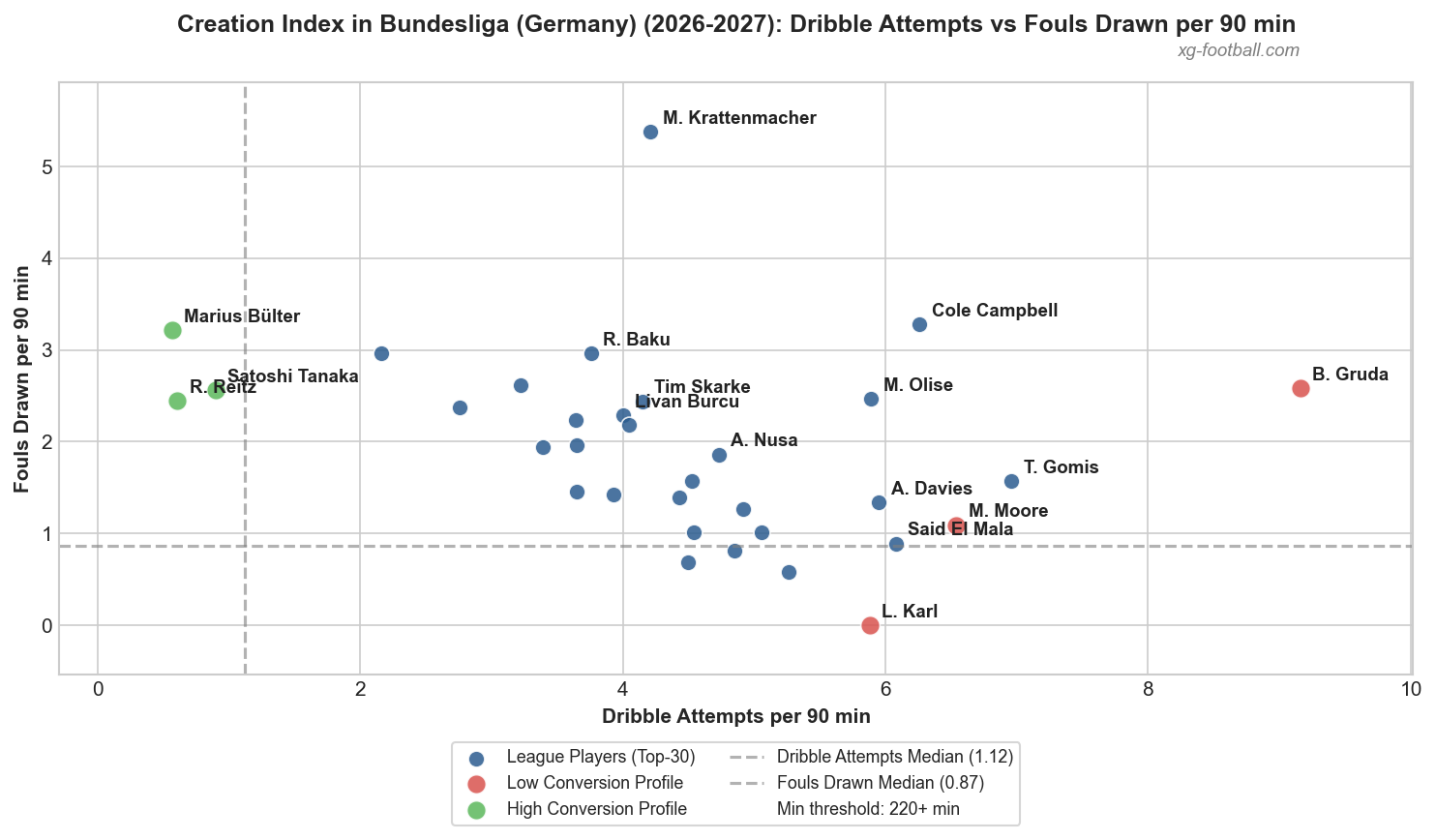
Creativity in modern football is not measured by goals and assists alone. The ability to beat an opponent one-on-one, carry the ball into dangerous areas and force defenders into committing fouls can be just as important in shaping an attack. The Bundesliga’s 2026/27 statistics reveal which players are most active in these areas — and highlight some surprising names among the league’s leading creative forces.
The analysis covers 245 players, each of whom has played at least 220 minutes. The league median is 1.12 dribble attempts and 0.87 fouls drawn. These figures provide a useful benchmark for evaluating individual attacking activity. Players significantly above both marks are particularly involved in one-on-one situations and regularly put opposing defenders under pressure.
However, the numbers also reveal different approaches to attacking play. Some players rely on frequent dribbling, while others are more effective at drawing contact and winning free kicks without attempting many take-ons. The combination of these qualities offers an interesting picture of creativity across the competition.
The Leaders: Gruda Tops the Ranking as Elversberg Make Their Mark
B. Gruda of RB Leipzig leads the overall ranking with a combined figure of 11.74, recording 9.16 dribble attempts and 2.58 fouls drawn. His dribbling volume is comfortably the highest among the players listed. Across 383 minutes, Gruda has demonstrated an outstanding willingness to take on opponents and create attacking opportunities through individual skill.
One of the biggest surprises is the presence of two SV Elversberg players in the top three. M. Krattenmacher occupies second place with 9.59. His 4.21 dribble attempts are impressive, but it is his exceptional 5.38 fouls drawn that make the difference. No other player in the top 12 comes close to that figure.
His teammate Cole Campbell follows closely in third with 9.54. Campbell has recorded 6.26 dribble attempts and 3.28 fouls drawn in just 302 minutes. That combination makes him one of the most dynamic attacking players in the sample, particularly considering his relatively limited playing time.
T. Gomis of RB Leipzig takes fourth place with 8.53. His 6.96 dribble attempts point to an aggressive approach in possession, although his 1.57 fouls drawn suggest that his game is more heavily built around taking on defenders than winning free kicks.
M. Olise of Bayern München completes the top five with 8.36. His figures — 5.89 dribble attempts and 2.47 fouls drawn — underline his ability to combine close control with the capacity to attract defensive pressure. Olise has also played 657 minutes, the highest total among the top five.
Further down the ranking, M. Moore of 1. FC Köln stands out with 6.54 dribble attempts and a combined score of 7.63. A. Davies of Bayern München follows on 7.29, while Said El Mala of 1. FC Köln reaches 6.97. Their presence confirms that the league’s most active dribblers are spread across several clubs rather than concentrated exclusively among the title contenders.
R. Baku and A. Nusa give RB Leipzig two more representatives in the top 12, with combined scores of 6.72 and 6.59 respectively. Tim Skarke and Livan Burcu complete the list for Union Berlin, recording 6.59 and 6.29. The spread of names highlights the variety of attacking profiles contributing to the league’s creative play.
The Anomalies: High Workload, Different Returns
Not every player who attempts a large number of dribbles manages to turn that activity into fouls won. The low-conversion profile identifies footballers whose dribbling volume is high relative to their fouls drawn. It should not, however, be confused with poor finishing or a lack of support from teammates: these statistics do not show whether a dribble created a shooting opportunity, opened space or led to a successful attacking move.
B. Gruda of RB Leipzig appears in this category as well as at the top of the overall ranking. His 9.16 dribble attempts are accompanied by 2.58 fouls drawn, leaving a difference of 6.58. This does not diminish his attacking influence, but it does show that his willingness to take on defenders does not translate into an equally high number of free kicks.
L. Karl of Bayern München presents an even more unusual case. He recorded 5.88 dribble attempts but drew no fouls in the sample. Meanwhile, M. Moore of 1. FC Köln registered 6.54 dribble attempts and 1.09 fouls drawn, producing a difference of 5.45. Both players feature among the most active dribblers, but their figures suggest that winning contact is not a major part of the return from their individual actions.
Efficiency Specialists: Winning Fouls Without Constant Dribbling
At the opposite end of the spectrum are players who draw plenty of fouls despite attempting relatively few dribbles. Their profiles suggest a different kind of attacking intelligence: using positioning, timing, close control and body movement to make defenders commit challenges.
Marius Bülter of 1. FC Köln leads this group. He averages just 0.57 dribble attempts but draws an impressive 3.22 fouls. That contrast makes him one of the clearest examples of a player who can win contact without repeatedly trying to beat opponents with the ball.
R. Reitz of RB Leipzig follows a similar pattern, with 0.61 dribble attempts and 2.45 fouls drawn. Satoshi Tanaka of FC Schalke 04 completes the group, recording 0.90 dribble attempts alongside 2.56 fouls drawn.
These players demonstrate that attacking influence does not always require a high volume of take-ons. Drawing fouls can help a team move up the pitch, relieve pressure, disrupt an opponent’s defensive rhythm and create opportunities from set pieces. In that respect, Bülter, Reitz and Tanaka offer a useful contrast to the more direct dribbling approach of Gruda and Gomis.
What the Numbers Tell Us About Bundesliga Creativity
The 2026/27 data reveal several distinct attacking profiles. Gruda of RB Leipzig is the standout dribbler by volume, while Krattenmacher of SV Elversberg leads the top group in fouls drawn. Cole Campbell of SV Elversberg combines both qualities impressively, and Olise of Bayern München continues to demonstrate the value of individual skill.
At the same time, the comparison between high-volume dribblers and foul-winning specialists shows why creativity cannot be reduced to a single statistic. Some players create pressure through repeated one-on-one challenges; others are adept at drawing defenders into mistakes with relatively little dribbling.
The league medians of 1.12 dribble attempts and 0.87 fouls drawn provide the baseline, but the players at the top of these rankings operate well beyond it in at least one category. Their contrasting styles offer a compelling snapshot of the many ways attacking footballers can influence a match — whether through direct running, clever movement or the ability to make defenders commit a foul at precisely the wrong moment.