
Dribbling Kings and Foul-Winning Specialists: Who Creates the Most Problems in Ligue 1 in 2026/27?
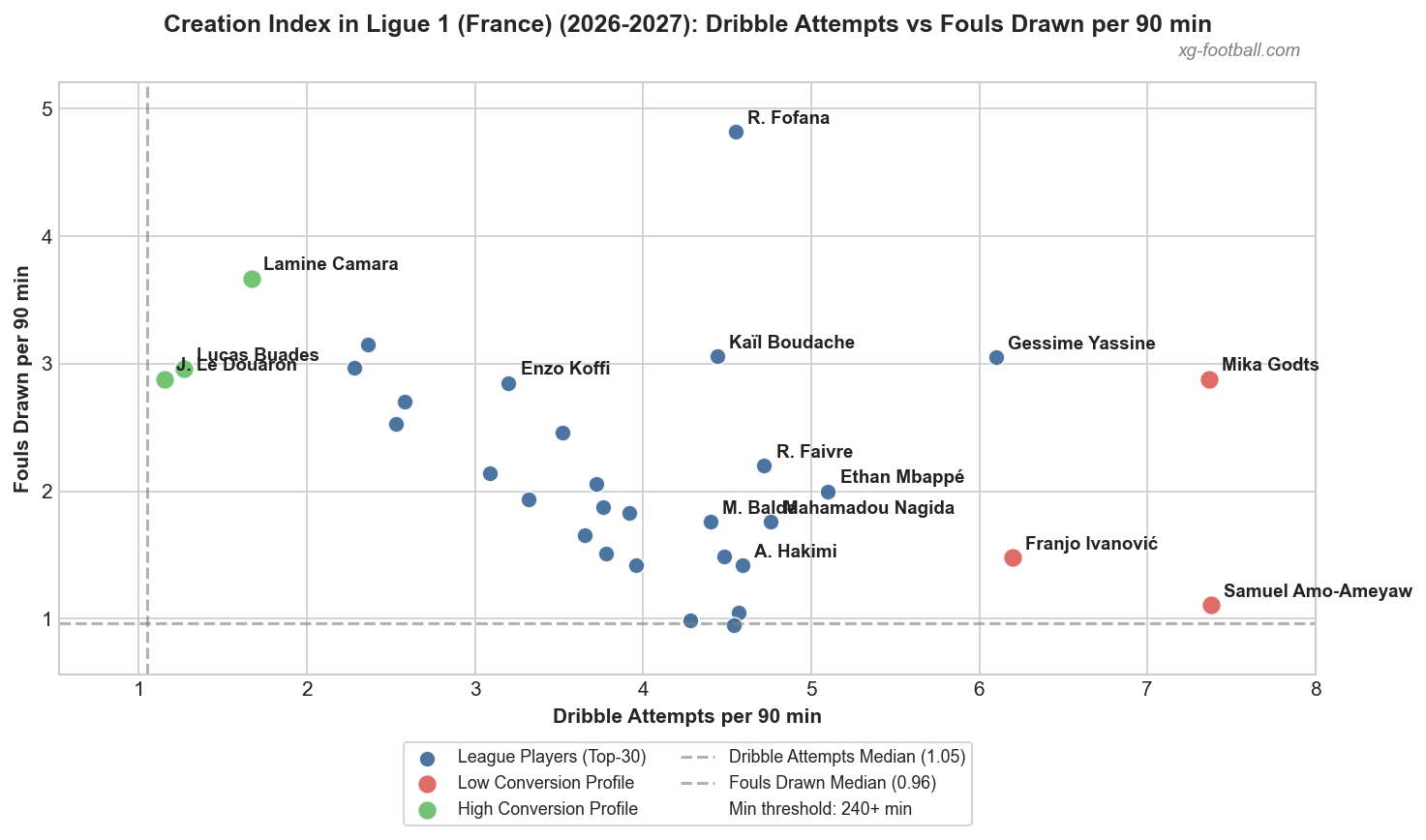
Beating an opponent in a one-on-one situation and forcing defenders into committing fouls are two essential weapons in modern attacking football. Some players constantly take on their markers, stretching defensive lines and creating space for teammates. Others are particularly effective at using their positioning, movement and timing to draw challenges and win valuable free kicks. The 2026/27 Ligue 1 statistics reveal which players are making the biggest impact in these areas.
A total of 258 players were included in the analysis, with a minimum playing-time requirement of 240 minutes. The league median stands at 1.05 dribble attempts and 0.96 fouls drawn. These figures provide a benchmark for assessing individual attacking activity. Several players comfortably outperform both averages, although their approaches differ considerably: some rely on relentless dribbling, while others combine individual skill with an impressive ability to provoke defensive mistakes.
Leaders: Mika Godts Tops the Rankings as Strasbourg Makes Its Mark
The standout performer in the overall ranking is Mika Godts (Paris Saint-Germain). His figures of 7.37 dribble attempts and 2.88 fouls drawn produce a combined score of 10.25, the highest among all players analysed. His dribbling activity is particularly remarkable, exceeding the league median by approximately seven times. Having accumulated 281 minutes, Godts has already demonstrated an exceptional willingness to take on defenders, although a longer playing-time sample will provide a clearer indication of his consistency.
Second place belongs to R. Fofana (Le Havre), who records 9.37. His profile is notably more balanced, combining 4.55 dribble attempts with an impressive 4.82 fouls drawn. The latter figure is the highest among the top three players in the overall ranking. Fofana does not simply look to beat his opponent; he also regularly forces defenders into committing fouls. His 336 minutes provide a reasonable sample behind this impressive output.
Third place goes to Gessime Yassine (Strasbourg), whose combined score reaches 9.15. His statistics include 6.10 dribble attempts and 3.05 fouls drawn. Particularly noteworthy is his playing time of 767 minutes — the highest among all players in the top 12. This makes his performance especially interesting, as his impressive numbers have been maintained over a considerably longer period than those of several competitors.
Another Strasbourg representative, Samuel Amo-Ameyaw, occupies fourth place with 8.49. His 7.38 dribble attempts are actually the highest figure in the entire dataset, narrowly surpassing Godts. However, he has drawn just 1.11 fouls. This suggests a player who constantly looks to challenge defenders individually but does not translate every attacking duel into a foul. His playing time of 244 minutes is also relatively limited, making further appearances important for evaluating the sustainability of his numbers.
Fifth place belongs to Franjo Ivanović (Lens), who records 7.68. His statistics show 6.20 dribble attempts and 1.48 fouls drawn. Like Amo-Ameyaw, Ivanović prefers an aggressive individual approach, frequently attempting to beat his direct opponent. However, his ability to win fouls is considerably less pronounced than his dribbling activity.
Kaïl Boudache (Lyon) follows in sixth place with 7.50. His 4.44 dribble attempts are complemented by 3.06 fouls drawn, creating a well-balanced attacking profile. He combines the willingness to take on defenders with an ability to benefit from the pressure they apply. His 324 minutes offer a useful foundation for assessing his contribution.
Seventh place belongs to Ethan Mbappé (Lille), who registers 5.10 dribble attempts and 2.00 fouls drawn, producing a total of 7.10. R. Faivre (Auxerre) sits just behind him with 6.92, combining 4.72 dribble attempts with 2.20 fouls drawn. His 572 minutes make him one of the more established performers in the leading group.
Mahamadou Nagida (Rennes) occupies ninth position with 6.52. His figures stand at 4.76 dribble attempts and 1.76 fouls drawn. Tenth place goes to M. Balde (Stade Brestois 29), who records 4.40 attempts and 1.76 fouls, producing a combined score of 6.16.
The final two positions belong to players from Le Havre and Paris Saint-Germain. Enzo Koffi (Le Havre) registers 6.05, with 3.20 dribble attempts and 2.85 fouls drawn. Meanwhile, A. Hakimi (Paris Saint-Germain) completes the top 12 with 6.01. His figures include 4.59 dribble attempts and 1.42 fouls drawn. Having played 569 minutes, Hakimi also provides one of the more substantial playing-time samples in the ranking.
One of the most interesting team-level trends is Strasbourg's representation in the top four. Yassine combines dribbling with an ability to win fouls, while Amo-Ameyaw leads the entire dataset in dribble attempts. Le Havre also has two representatives in the top 12 through Fofana and Koffi, both of whom demonstrate an ability to draw fouls. Paris Saint-Germain, meanwhile, features both Godts and Hakimi, although their statistical profiles are quite different.
Anomalies: Relentless Dribblers and Masters of Winning Fouls
The most revealing aspect of the rankings is the difference between dribble attempts and fouls drawn. Some players constantly challenge defenders but generate relatively few free kicks in return. Others take fewer risks in one-on-one situations yet regularly force opponents into committing fouls. These contrasting profiles provide an interesting insight into how attacking players create pressure.
Samuel Amo-Ameyaw (Strasbourg) is the clearest example of a high-volume dribbler with a comparatively modest foul return. His 7.38 dribble attempts are accompanied by just 1.11 fouls drawn, creating a difference of 6.27. He is constantly willing to take on opponents, but these individual challenges do not translate into fouls at the same rate.
A similar pattern can be seen with Franjo Ivanović (Lens). He records 6.20 dribble attempts and 1.48 fouls drawn, leaving a difference of 4.72. His numbers suggest an attacking player who relies heavily on direct individual actions, although the statistical return in terms of winning free kicks is considerably smaller.
Mika Godts (Paris Saint-Germain) also appears in this category, with 7.37 dribble attempts and 2.88 fouls drawn. The difference stands at 4.49. However, his inclusion should not be interpreted as evidence of poor overall efficiency. Godts leads the main ranking with 10.25, and his figures demonstrate an exceptionally high level of attacking involvement. The classification simply highlights his preference for dribbling rather than relying primarily on winning fouls.
These players can be viewed as attacking catalysts who regularly attempt to break defensive lines through individual skill. Their willingness to take on opponents can create space, force defensive adjustments and open opportunities for teammates. However, the available statistics do not establish whether their dribbles result in clear-cut chances or whether teammates fail to convert opportunities. Additional data on chances created, key passes and expected assists would be needed to assess that aspect of their contribution.
At the opposite end of the spectrum are players who demonstrate a particularly strong relationship between their dribbling activity and the number of fouls they win.
Lamine Camara (Monaco) leads the high-conversion group. He records just 1.67 dribble attempts but draws an impressive 3.67 fouls. The difference is minus 2.00, meaning he wins considerably more fouls than the number of dribble attempts recorded. His figures suggest an ability to use positioning, movement and timing to force defenders into making mistakes without constantly attempting to beat them one-on-one.
Second place belongs to J. Le Douaron (Estac Troyes), whose 1.15 dribble attempts are accompanied by 2.88 fouls drawn. The difference stands at minus 1.73. He is not among the league's most active dribblers, but his ability to win free kicks is particularly notable relative to his dribbling volume.
Lucas Buades (Le Mans) completes the group with a difference of minus 1.69. His statistics include 1.27 dribble attempts and 2.96 fouls drawn. Like Camara and Le Douaron, he demonstrates that consistently winning fouls does not necessarily require a high volume of direct one-on-one challenges.
These players represent a different type of attacking effectiveness. Rather than constantly looking to beat defenders, they appear more capable of turning individual situations into favourable free kicks. Their contribution can be particularly valuable in matches where space is limited and set-piece opportunities become an important attacking weapon.
Conclusion: Dribbling Creates Pressure, Fouls Turn It into an Advantage
The 2026/27 Ligue 1 statistics reveal several distinct attacking profiles among the 258 players analysed. Mika Godts (Paris Saint-Germain) leads the overall ranking with 10.25, demonstrating exceptional dribbling activity. R. Fofana (Le Havre) and Gessime Yassine (Strasbourg) follow with impressive combinations of individual attacking actions and fouls won.
Meanwhile, Amo-Ameyaw and Ivanović highlight the difference between attempting to beat defenders and successfully drawing fouls. The examples of Lamine Camara, Le Douaron and Buades demonstrate the opposite: a player does not need to attempt numerous dribbles to become particularly effective at winning free kicks.
The main takeaway is that individual attacking activity and the ability to benefit from defensive pressure are two different but complementary qualities. Some players constantly take responsibility in one-on-one situations, while others are more effective at using their movement and positioning to force opponents into mistakes. Both approaches can create valuable attacking advantages.
As the season progresses and players accumulate more minutes, the rankings may change. For now, however, Godts has established the individual benchmark, Fofana stands out as one of the most balanced performers, and Strasbourg has emerged as one of the most interesting sources of attacking talent in the current dataset.