
Europe’s attacking elite: Saibari leads the shot count as Raphinha delivers the goals
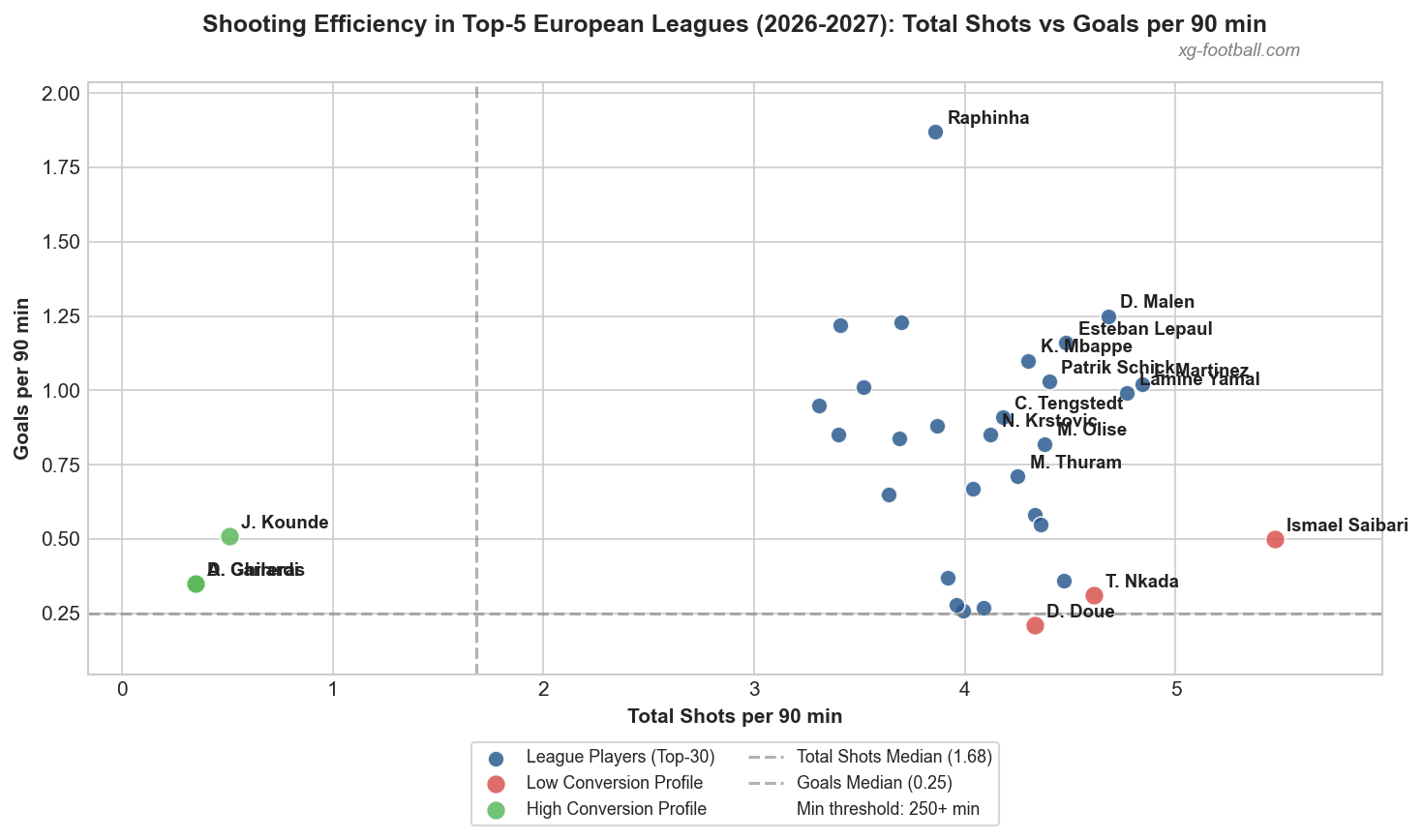
The 2026/27 season across Europe’s top five leagues is producing a fascinating contrast between attacking volume and finishing efficiency. Among 607 players who reached the minimum threshold of 250 minutes, the league-wide median stands at 1.68 shots and 0.25 goals. These benchmarks offer a useful starting point for identifying players who consistently threaten goal and those who make the most of fewer opportunities.
At the top of the combined ranking, Ismael Saibari (Bayern München) leads with 5.97, driven by an exceptional 5.47 shots alongside 0.50 goals. Yet the most productive finisher in the leading group is Raphinha (Barcelona), whose goal figure of 1.87 is the highest among the 12 players listed. Their contrasting profiles capture the central theme of the data: shooting frequently and scoring consistently are related, but they are not the same skill.
The leaders: Who is setting the attacking pace?
Ismael Saibari (Bayern München) occupies first place with a combined score of 5.97. His 5.47 shots are comfortably the highest figure in the top 12 and more than three times the league median. Across 362 minutes, he has established himself as one of the most active shooters in the sample. His goal figure of 0.50, however, is comparatively modest, leaving room for his scoring output to catch up with his remarkable attacking volume.
Second place belongs to D. Malen (AS Roma), who combines 4.68 shots with 1.25 goals for a total of 5.93. He trails Saibari by only 0.04, but his profile is more balanced between attempts and scoring. L. Martinez (Inter) ranks third at 5.86, with 4.84 shots and 1.02 goals. Despite recording 353 minutes, Martinez has already produced numbers that place him among the standout attacking contributors in this group.
Lamine Yamal (Barcelona) follows in fourth place with a combined figure of 5.76, built on 4.77 shots and 0.99 goals. His 905 minutes represent one of the largest playing-time totals among the leaders, providing a longer stretch of involvement behind his numbers. Barcelona teammate Raphinha (Barcelona) is just behind him at 5.73, but leads the group for goals with 1.87. His 3.86 shots are fewer than those of several rivals, yet his scoring output makes him one of the most compelling profiles in the ranking.
In sixth place, Esteban Lepaul (Rennes) records 4.48 shots and 1.16 goals, producing a combined score of 5.64. Patrik Schick (Bayer Leverkusen) follows at 5.43, with 4.40 shots and 1.03 goals. Both exceed the league medians by a considerable margin in both categories, demonstrating the value of combining regular shooting with a strong goal return.
K. Mbappe (Real Madrid) sits eighth with 4.30 shots and 1.10 goals, giving him a total of 5.40. His 984 minutes are the highest in the top 12, making his figures notable for the length of the playing-time sample. He remains among the strongest performers for both attacking activity and goals.
The remaining places are occupied by M. Olise (Bayern München), with 4.38 shots and 0.82 goals; C. Tengstedt (Toulouse), with 4.18 and 0.91; N. Krstovic (Atalanta), with 4.12 and 0.85; and M. Thuram (Inter), with 4.25 and 0.71. Their combined figures range from 4.96 to 5.20. All four comfortably exceed the median for shots, although their goal returns vary significantly.
The ranking therefore features two distinct types of attacking leader. Saibari (Bayern München) sets the pace through sheer shooting volume, while Raphinha (Barcelona), D. Malen (AS Roma) and K. Mbappe (Real Madrid) stand out for their stronger goal figures. The most complete profiles are those that combine frequent attempts with output well above the league median.
Low conversion: When effort does not bring enough reward
The clearest example of a gap between attacking activity and scoring output is Ismael Saibari (Bayern München). His 5.47 shots lead the top 12, but his goal figure stands at 0.50. That combination places him in both the overall leadership group and the low-conversion category. His attacking involvement is undeniable, yet his scoring return does not currently match the scale of his shooting activity.
T. Nkada (Estac Troyes) presents a similar pattern, recording 4.61 shots alongside 0.31 goals. His shot figure is almost three times the league median, while his goal output is only slightly above the median of 0.25. He is regularly getting attempts away, but the available figures show a much more limited scoring return than his volume might suggest.
D. Doue (Paris Saint Germain) also features in the low-conversion group. His 4.33 shots are well above the typical level, but his goal figure of 0.21 falls below the league median. The contrast highlights how a player can be heavily involved in finishing attacks without producing a corresponding goal return.
These figures point to a difference between generating attempts and converting them into goals. However, they do not prove that any player is simply finishing poorly. Shot quality, shooting distance, defensive pressure and goalkeeper performance all influence the outcome. The statistics identify a gap between volume and output, while further data would be needed to explain its causes.
High conversion: Making limited opportunities count
At the other end of the spectrum, J. Kounde (Barcelona) records 0.51 shots and 0.51 goals. Both figures are below the league median for shots, but their equality makes his profile stand out in this dataset. Rather than relying on a high volume of attempts, his listed numbers show a goal figure matching his shooting figure.
A. Carreras (Real Madrid) records 0.35 shots and 0.35 goals, while D. Ghilardi (AS Roma) posts the same figures. Both have relatively low shooting volumes, yet their goal figures are notable in relation to that activity. These profiles provide a counterpoint to the high-volume shooters: attacking output does not always require a constant stream of attempts.
There is an important caveat, however. Low-volume profiles can be especially sensitive to the size of the sample, and the figures alone do not establish a sustainable conversion rate. Players may take fewer but better-positioned attempts, occupy roles that limit their shooting opportunities, or simply be experiencing a productive spell. The data identify an interesting pattern, not a guarantee of future performance.
The bigger picture: Volume matters, but balance matters more
The figures from 607 players across Europe’s top five leagues reveal several distinct attacking profiles. The median benchmarks of 1.68 shots and 0.25 goals help separate those who stand out for their activity from those who excel at turning opportunities into scoring output.
Ismael Saibari (Bayern München) leads the combined ranking through his exceptional shooting volume, while D. Nkada (Estac Troyes) and D. Doue (Paris Saint Germain) also illustrate the gap that can emerge between attempts and goals. At the other end, Raphinha (Barcelona) and D. Malen (AS Roma) combine substantial shooting activity with strong goal figures, while J. Kounde (Barcelona), A. Carreras (Real Madrid) and D. Ghilardi (AS Roma) stand out for their goal figures relative to their limited shooting volume.
The central lesson is that neither shots nor goals tells the whole story on its own. Shot volume reveals how frequently a player participates in the final attacking action; goals show the outcome. Reading the two together offers a more useful picture of attacking contribution, while shot-quality data and tactical context would help explain which performances are most likely to continue.