
Premier League 2026/27: Haaland leads the attacking race as Delap fires often but struggles to score
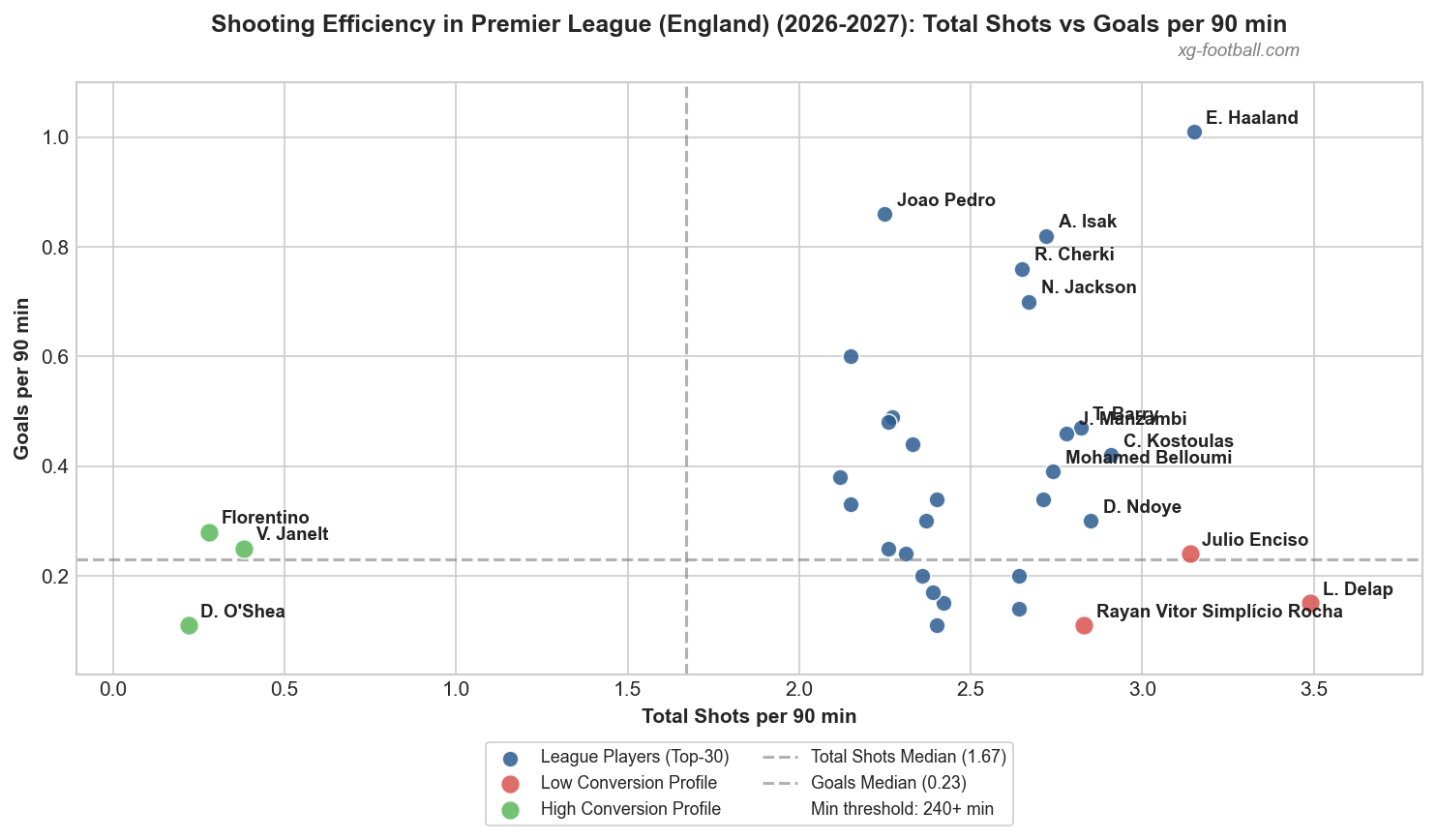
The Premier League’s attacking numbers for the 2026/27 season reveal a compelling contrast between volume and efficiency. Across a sample of 117 players who met the minimum threshold of 240 minutes, the median stood at 1.67 total shots and 0.23 goals. These figures offer a useful benchmark for separating players who consistently threaten goal from those who make the most of limited opportunities.
At the top of the combined ranking, E. Haaland (Manchester City) sets the pace with 3.15 shots and 1.01 goals, producing a combined figure of 4.16. Yet the leaderboard is not simply a list of prolific finishers. Some players generate substantial shooting volume without converting it into goals, while others deliver impressive returns despite attempting relatively few shots. That tension between activity and output is one of the season’s most intriguing statistical storylines.
Leaders: Haaland sets the standard
E. Haaland (Manchester City) occupies first place among the 12 leading players, combining the highest listed goal figure, 1.01, with 3.15 shots. His combined score of 4.16 places him comfortably ahead of the rest of the group. With 800 minutes recorded, he also has the largest playing-time total among these leaders, giving his numbers a substantial foundation.
L. Delap (Nottingham Forest) ranks second with 3.49 shots and a combined figure of 3.64. His shooting volume is actually higher than Haaland’s, but his goal figure of 0.15 tells a very different story. Delap is a constant presence in the shooting statistics, though the conversion of that activity into goals remains a major question.
Third place belongs to A. Isak (Liverpool), whose 2.72 shots and 0.82 goals produce a combined score of 3.54 across 661 minutes. His numbers show a strong balance between creating attempts and finding the net. Just behind him, R. Cherki (Manchester City) records 2.65 shots and 0.76 goals, reaching 3.41 in 475 minutes. Cherki’s output is particularly notable given his comparatively limited playing time within this group.
Julio Enciso (Ipswich) sits fifth with 3.14 shots and 0.24 goals, for a combined figure of 3.38. Like Delap, he ranks among the most active shooters but has a much lower goal return than the leading finishers. N. Jackson (Aston Villa) follows closely with 2.67 shots and 0.70 goals, while C. Kostoulas (Brighton) posts 2.91 shots and 0.42 goals. Their combined figures of 3.37 and 3.33 respectively place them firmly among the tournament’s leading attacking contributors.
The next tier features T. Barry (Everton), with 2.82 shots and 0.47 goals across 765 minutes, and J. Manzambi (Aston Villa), who records 2.78 shots and 0.46 goals in 389 minutes. Manzambi’s combined figure is approximately 3.24, putting him just below Kostoulas and Barry in the ranking.
D. Ndoye (Nottingham Forest) contributes 2.85 shots and 0.30 goals, while Mohamed Belloumi (Hull City) records 2.74 shots and 0.39 goals. Both exceed the league median for shots, although their goal figures sit closer to the middle of the leaderboard. Completing the top 12, Joao Pedro (Chelsea) stands out for his 0.86 goals alongside 2.25 shots. His combined score of 3.11 is the lowest in this leading group, but his goal figure is second only to Haaland’s, underlining the importance of finishing efficiency as well as shooting frequency.
The unlucky ones: Plenty of attempts, limited reward
The clearest example of high effort and modest returns is L. Delap (Nottingham Forest). His 3.49 shots are the highest figure among the top 12, more than double the league median of 1.67. Yet his goal figure is just 0.15, below the league median of 0.23. The gap between his shooting activity and goal output makes him one of the most striking low-conversion profiles in the dataset.
Julio Enciso (Ipswich) presents a similar pattern. With 3.14 shots, he is another player who regularly gets attempts away, but his 0.24 goals provide only a modest return. Although his goal figure is slightly above the league median, it remains low relative to his shooting volume. More attempts do not automatically translate into a stronger scoring contribution.
Rayan Vitor Simplício Rocha (Bournemouth) also appears in the low-conversion group, registering 2.83 shots and just 0.11 goals. His shooting figure is well above the league median, while his goal output is substantially below it. This profile suggests a player involved in attacking moves and willing to shoot, but whose end product has so far failed to match his activity.
These figures do not, on their own, prove that the players are finishing badly. Shot quality, the positions from which attempts are taken, defensive pressure and goalkeeper performance can all influence the final return. Nevertheless, the contrast is clear: Delap, Enciso and Rayan Vitor Simplício Rocha are generating shooting volume without a correspondingly high goal figure.
The efficient few: Goals without heavy shooting volume
At the other end of the spectrum, Florentino (Ipswich) records 0.28 shots and 0.28 goals. Both figures are low in absolute terms, but their equality makes him an intriguing example of output matching shooting volume in this dataset. His numbers suggest that he does not rely on frequent attempts to produce his listed goal return, although the sample alone cannot establish how sustainable that pattern will be.
D. O'Shea (Ipswich) registers 0.22 shots and 0.11 goals, while V. Janelt (Brentford) records 0.38 shots and 0.25 goals. Both have shooting figures far below the league median, yet their goal figures are comparatively strong relative to that limited volume. Janelt’s 0.25 goals also place him slightly above the overall median of 0.23.
These profiles offer a useful counterpoint to the high-volume shooters. A player does not necessarily need to lead the league in attempts to make a contribution on the scoreboard. However, low-volume, high-return patterns should be interpreted carefully: they may reflect smart shot selection, specific tactical roles or a particularly productive stretch rather than a guaranteed level of future output.
What the numbers tell us
The 2026/27 Premier League data point to three distinct attacking profiles. E. Haaland (Manchester City) combines high shooting volume with the strongest goal figure among the leaders. L. Delap (Nottingham Forest) and Julio Enciso (Ipswich) demonstrate how frequent attempts can coexist with comparatively modest scoring returns. Meanwhile, Florentino (Ipswich) and V. Janelt (Brentford) illustrate the contrasting profile of players producing goals despite limited shooting volume.
The league medians provide the essential context: 1.67 shots and 0.23 goals. Players well above both benchmarks are contributing through sustained attacking activity and scoring output, while those who exceed one benchmark but fall short of the other reveal a more uneven profile. The most useful reading of these statistics is therefore not simply who shoots most or scores most, but how effectively each player turns involvement into results.