
La Liga 2026/27: Yamal Sets the Pace as Raphinha Leads the Scoring Charge
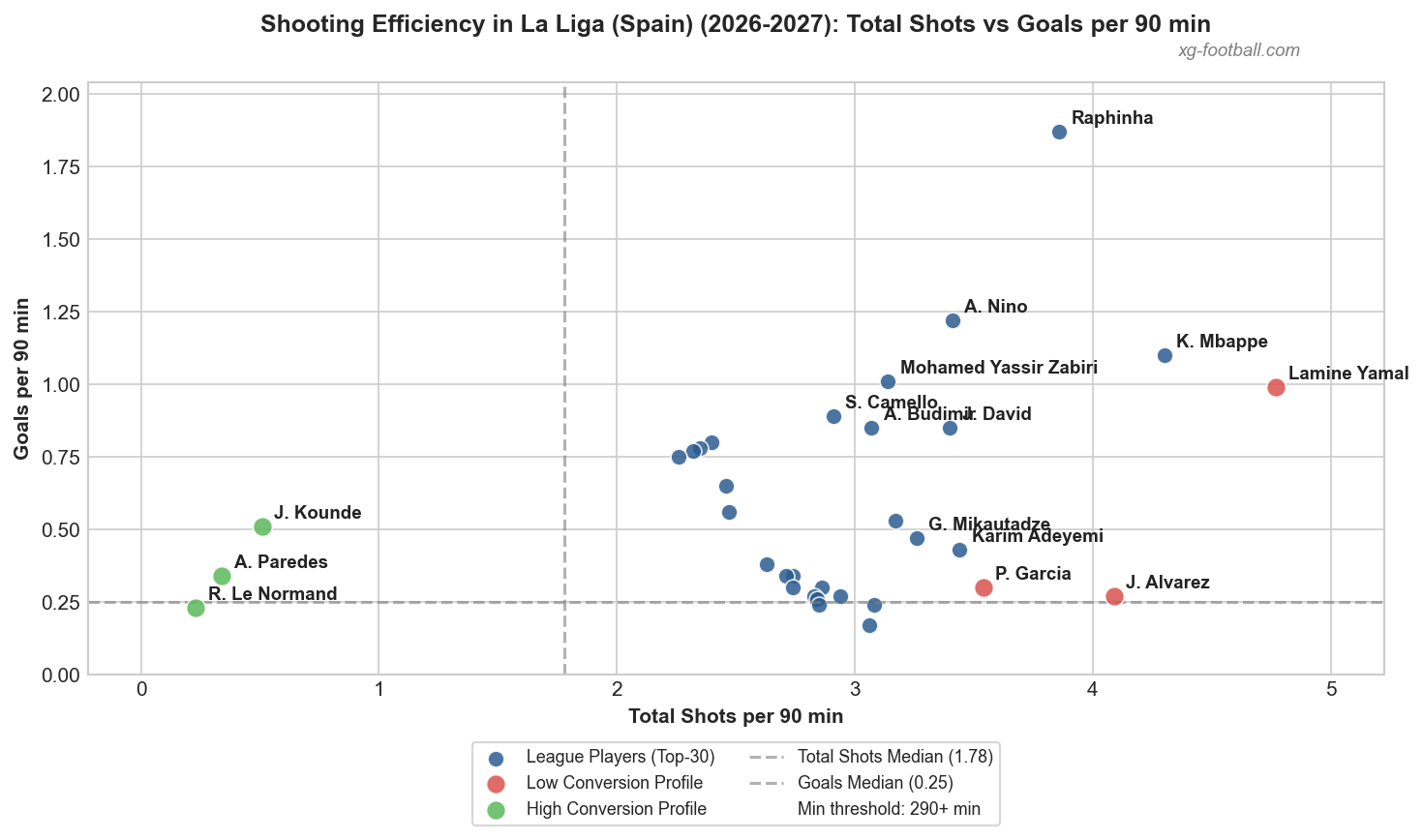
The 2026/27 La Liga season is producing a fascinating contrast between attacking volume and finishing efficiency. Across a sample of 141 players who have played at least 290 minutes, the league median stands at 1.78 shots and 0.25 goals. These figures provide a useful benchmark for identifying players who consistently threaten goal and those who turn their attacking involvement into particularly impressive scoring returns.
Barcelona dominate the top end of the rankings, with Lamine Yamal and Raphinha leading the way in different respects. Real Madrid's K. Mbappe remains firmly in contention, while several players from clubs outside Spain's traditional powerhouses are making their mark. The numbers also reveal a familiar footballing paradox: shooting frequently does not always translate into goals, while some players produce striking returns from comparatively few attempts.
The Leaders: Barcelona's Duo and Mbappe Set the Standard
Lamine Yamal (Barcelona) tops the ranking with a combined shots-and-goals figure of 5.76, built on 4.77 shots and 0.99 goals. His shooting volume is almost three times the league median, underlining how frequently he becomes involved in the final phase of attacks. Across 905 minutes, Yamal has established himself as one of the competition's most active attacking threats, combining regular attempts with a substantial goal contribution.
Close behind is Raphinha (Barcelona), whose combined figure of 5.73 places him just behind his teammate. His 3.86 shots are fewer than Yamal's, but his goal figure of 1.87 is the highest among the 12 leading players. That contrast makes Raphinha one of the most striking performers in the sample: he pairs a high level of shooting activity with an even more impressive scoring return. Barcelona's presence at the summit reflects two complementary attacking profiles rather than reliance on a single source of danger.
K. Mbappe (Real Madrid) occupies third place with 4.30 shots and 1.10 goals, producing a combined figure of 5.40. His numbers place him comfortably above both league medians and confirm his importance as a high-volume attacking player. With 984 minutes recorded, Mbappe also has the largest playing-time total among the top three, providing a substantial sample for assessing his contribution.
One of the most intriguing names in the ranking is A. Nino (Malaga). In 370 minutes, he has recorded 3.41 shots and 1.22 goals. His goal figure is second only to Raphinha's among the top 12, despite a much lower shooting volume than Yamal or Mbappe. The numbers suggest an impressive return, although a relatively limited number of minutes means his longer-term consistency remains an open question.
J. Alvarez (Atletico Madrid) offers a contrasting profile. His 4.09 shots put him among the most active players in the ranking, but his goal figure stands at just 0.27. His combined value of approximately 4.36 remains strong, yet the gap between his shooting frequency and scoring output is one of the clearest talking points in the data. Teammate J. David (Atletico Madrid), by comparison, records 3.40 shots and 0.85 goals. Although his shooting volume is lower, his goal figure is considerably stronger relative to his attempts.
Beyond the biggest names, Mohamed Yassir Zabiri (Racing Santander) stands out with 3.14 shots and 1.01 goals. His scoring figure is comparable to those of several headline attackers despite a lower volume of attempts. A. Budimir (Osasuna) also delivers a balanced profile, registering 3.07 shots and 0.85 goals across 850 minutes. Both players comfortably exceed the league's median figures for shots and goals, demonstrating that productive attacking performances are not confined to the title contenders.
Karim Adeyemi (Barcelona) has produced 3.44 shots and 0.43 goals in 418 minutes. His shooting volume is high, but his goal figure is more modest than those of Barcelona's leading attacking pair. P. Garcia (Racing Santander) shows a similar imbalance, with 3.54 shots and 0.30 goals across 305 minutes. His attacking activity is well above the league median, while his scoring output remains much closer to the typical level.
The final two places in the top 12 belong to players with different strengths. S. Camello (Rayo Vallecano) records 2.91 shots and 0.89 goals, combining a relatively moderate shooting volume with a strong scoring figure. G. Mikautadze (Villarreal), meanwhile, posts 3.26 shots and 0.47 goals. His numbers indicate consistent involvement in attacking moves, although his goal output is less pronounced than Camello's.
The Unlucky Ones: When Effort Outpaces the Return
J. Alvarez (Atletico Madrid) is the clearest example of a high-volume attacker whose goal output has not kept pace with his shooting activity. His 4.09 shots are more than double the league median, yet his goal figure of 0.27 is only marginally above the median of 0.25. That does not automatically mean he has been wasteful: the available figures do not reveal the quality of his chances, the locations of his attempts or how often he has tested the goalkeeper. They do, however, highlight a gap between the frequency of his efforts and their scoring return.
Lamine Yamal (Barcelona) also appears in the low-conversion category, but his case requires a different interpretation. His 0.99 goals are a strong absolute figure, and he leads the overall ranking. His classification is therefore relative to his exceptional shooting volume of 4.77. The implication is not that Yamal has struggled to score, but that such frequent involvement in shooting opportunities creates expectations of an even greater return.
P. Garcia (Racing Santander) presents a more pronounced imbalance. He averages 3.54 shots but records only 0.30 goals. His shooting frequency is nearly twice the league median, while his goal figure is only slightly higher than the typical benchmark. If his scoring return improves while his current level of attacking involvement remains intact, he could become a considerably more productive threat.
These profiles underline an important distinction: high shooting volume is evidence of attacking involvement, not proof of poor finishing. Expected goals, shot placement, attempts on target and the quality of chances would be needed to establish whether the gap comes from finishing, chance selection or the situations in which players receive the ball.
The Efficient Ones: Big Returns From Limited Shooting Volume
At the other end of the spectrum, J. Kounde (Barcelona) records 0.51 shots and 0.51 goals. A. Paredes (Athletic Club) posts 0.34 for both figures, while R. Le Normand (Atletico Madrid) registers 0.23 shots and 0.23 goals. All three have matching values for shots and goals, creating unusual statistical profiles in which their goal figures equal their shooting figures.
The reported combined values for these players are listed as zero, but the individual figures do not support that calculation. Adding shots and goals gives 1.02 for Kounde, 0.68 for Paredes and 0.46 for Le Normand. More importantly, the relatively low shooting volumes mean these figures should be treated as intriguing statistical patterns rather than definitive proof of superior finishing ability.
Position and tactical role also matter. Players who do not regularly lead their team's attacking line may take fewer shots but still contribute through occasional goals. Their numbers should therefore not be compared directly with those of forwards such as Mbappe or Raphinha without considering the different responsibilities they perform on the pitch.
Small samples can also exaggerate apparent efficiency. A limited number of attempts may produce a high goal-to-shot relationship over a short period, but sustaining that pattern over a longer stretch is much more difficult. Additional information about minutes, chance quality and shooting locations would help determine how much of these profiles reflects repeatable performance and how much may be short-term variation.
What the Numbers Tell Us About La Liga
The 2026/27 sample reveals several distinct routes to attacking impact. Lamine Yamal (Barcelona) leads through sheer shooting volume and tops the combined ranking, while Raphinha (Barcelona) stands out for the highest goal figure among the leading 12. K. Mbappe (Real Madrid) combines frequent attempts with strong scoring output, while A. Nino (Malaga) and Mohamed Yassir Zabiri (Racing Santander) demonstrate that impressive goal figures can emerge beyond the league's most prominent clubs.
At the same time, the figures for J. Alvarez (Atletico Madrid) and P. Garcia (Racing Santander) show that attacking activity does not always translate into a proportionate number of goals. The low-volume profiles of J. Kounde (Barcelona), A. Paredes (Athletic Club) and R. Le Normand (Atletico Madrid) provide a counterpoint, although their small shooting totals demand caution when drawing conclusions about efficiency.
The league medians of 1.78 shots and 0.25 goals offer a useful baseline, but they tell only part of the story. A fuller assessment would require expected-goals data, shot accuracy, chance quality and tactical context. Even so, the contrast is clear: the most influential attacking players are not defined solely by how often they shoot or how many goals they score, but by the relationship between those two measures. In La Liga, that relationship is producing a compelling contest between volume, precision and the ability to make every opportunity count.