
Serie A 2026/27: The Fine Line Between Shooting Volume and Goals
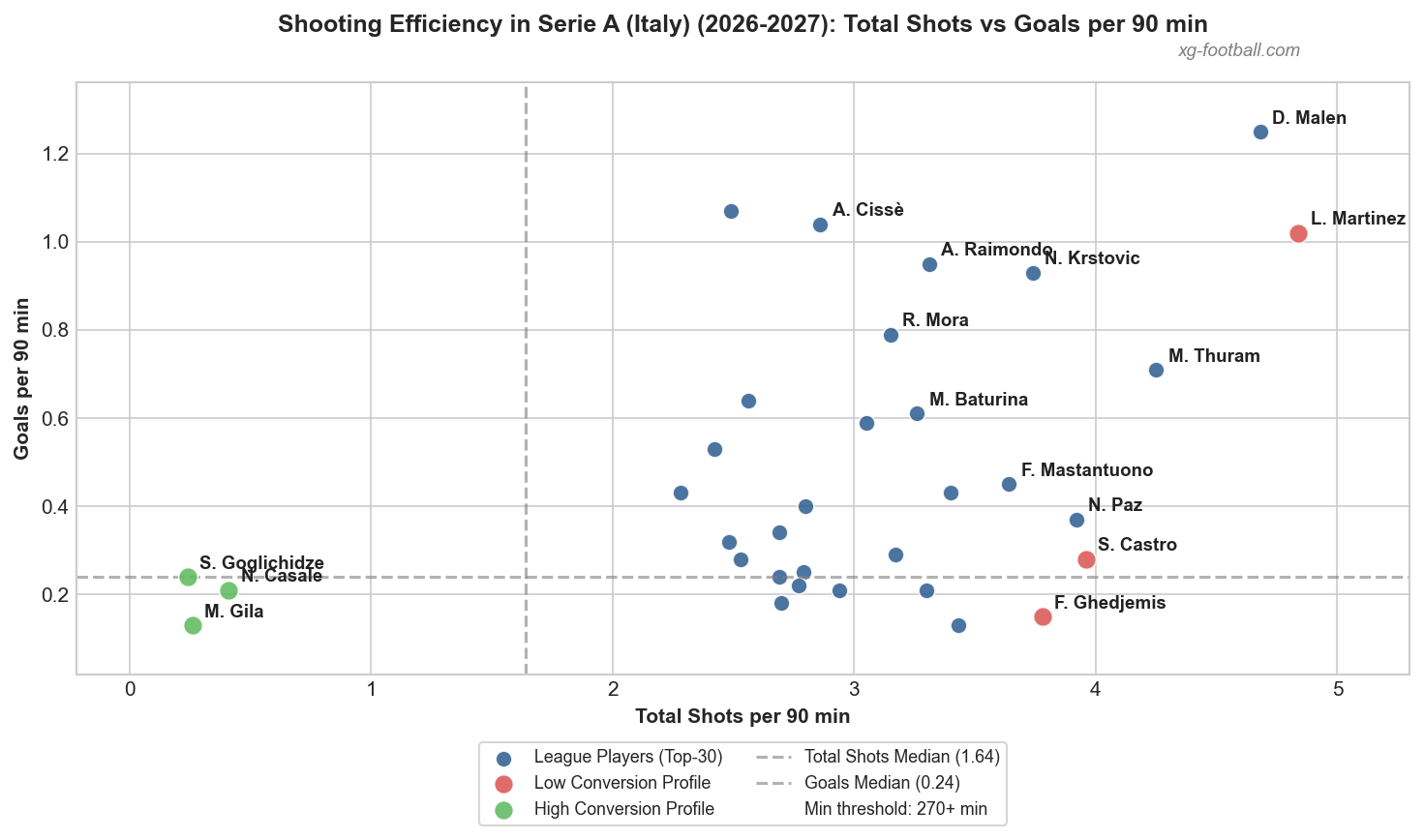
The 2026/27 Serie A season offers an intriguing snapshot of attacking performance, revealing how differently players turn shooting opportunities into goals. Across a sample of 138 players who have played at least 270 minutes, the league median stands at 1.64 total shots and 0.24 goals. These figures provide a useful benchmark for identifying the players who consistently threaten opposition defences and those whose attacking efforts produce particularly strong or modest returns.
At the top of the rankings, AS Roma and Inter feature prominently, but the leading players have different strengths. Some generate a relentless stream of attempts, while others stand out for their goal output relative to their shooting volume. The contrast between these profiles highlights one of football's enduring questions: how much does attacking success depend on creating chances, and how much depends on converting them?
The Leaders: Malen Sets the Pace
D. Malen (AS Roma) leads the rankings with a combined shots-and-goals figure of 5.93, built on 4.68 shots and 1.25 goals. His shooting volume is almost three times the league median, while his goal figure is substantially above the typical benchmark. The combination makes him the standout attacking performer in this sample, bringing both consistent involvement in finishing moves and a strong statistical return.
L. Martinez (Inter) follows with 4.84 shots and 1.02 goals, giving him a combined figure of approximately 5.86. He actually leads the top 12 in shooting volume, underlining his central role in Inter's attacking play. His goal output is also impressive, although the gap between his frequent attempts and his scoring figure leaves room for debate about whether his attacking activity could yield an even greater return.
Inter's attacking threat does not stop there. M. Thuram (Inter) ranks third with 4.25 shots and 0.71 goals, giving the club another player who consistently features in the final phase of attacks. Together, Martinez and Thuram illustrate the importance of having multiple players capable of generating attempts and applying pressure on opposing defences.
N. Krstovic (Atalanta) is another prominent name, recording 3.74 shots and 0.93 goals. His scoring figure compares favourably with several players who shoot more frequently, suggesting a particularly productive attacking profile in this dataset. By contrast, N. Paz (Como) registers 3.92 shots but 0.37 goals. His numbers point to a player heavily involved in shooting opportunities whose goal output has not risen at the same rate.
A. Raimondo (Frosinone) offers one of the most compelling combinations of volume and output outside the leading positions. With 3.31 shots and 0.95 goals across 761 minutes, he records a goal figure close to that of Krstovic despite taking fewer shots. His profile suggests that consistent attacking involvement does not have to mean leading the league in attempts to deliver a strong scoring return.
The contrast is particularly striking at AS Roma, where S. Castro records 3.96 shots but only 0.28 goals across 318 minutes, while R. Mora produces 3.15 shots and 0.79 goals in 343 minutes. The two profiles show how players at the same club can contribute to attacking play in markedly different ways. Castro generates attempts at a high rate, whereas Mora's goal figure is considerably stronger relative to his shooting volume.
F. Mastantuono (Fiorentina) records 3.64 shots and 0.45 goals over 792 minutes, establishing himself as a regular attacking contributor. F. Ghedjemis (Frosinone), meanwhile, posts 3.78 shots but just 0.15 goals across 596 minutes, making him one of the clearest examples of a gap between shooting activity and scoring output.
The remaining players add further variety to the picture. A. Cissè (AC Milan) records 2.86 shots and 1.04 goals, an impressive goal figure relative to his attempt volume. M. Baturina (Como) contributes 3.26 shots and 0.61 goals, balancing regular shooting with a more substantial scoring return than several players with comparable levels of activity.
The Unlucky Ones: When Attacking Effort Does Not Tell the Whole Story
L. Martinez (Inter) appears in the low-conversion profile despite recording 1.02 goals alongside a league-leading 4.84 shots among the top 12. This is not a claim that he has been unproductive in absolute terms. Rather, his inclusion highlights the distinction between strong scoring numbers and the potential return expected from such a high volume of attempts. His figures remain among the best in the sample, but the relationship between shooting frequency and goals is worth watching.
S. Castro (AS Roma) presents a more pronounced imbalance. His 3.96 shots are among the highest figures in the ranking, yet his goal output stands at only 0.28. He is clearly involved in finishing attacking moves, but that activity has not translated into a similarly high scoring figure. Improved finishing could make a substantial difference to his overall contribution, although the data alone cannot establish whether the issue lies in execution, shot quality or the circumstances in which his attempts occur.
F. Ghedjemis (Frosinone) provides another example of high effort with limited output. His 3.78 shots are close to the figures of several leading attackers, but his 0.15 goals are among the lowest in the top 12. The disparity is striking, particularly when compared with players such as Raimondo, who record fewer shots but considerably higher goal figures. Further information on expected goals, shot locations and attempts on target would help determine whether Ghedjemis has suffered from poor finishing, low-quality chances or a combination of factors.
The Efficient Ones: Making Limited Opportunities Count
At the other end of the spectrum, S. Goglichidze (Monza) records 0.24 shots and 0.24 goals. The two figures are equal, making his profile unusual within the supplied data. His goal output matches his modest shooting figure, but the small volume means that the numbers should be treated cautiously rather than as definitive evidence of sustained elite finishing. The reported combined value of zero is inconsistent with the individual figures, which add up to 0.48.
M. Gila (AC Milan) records 0.26 shots and 0.13 goals. Although his absolute numbers are low, the goal figure is notable relative to his shooting volume. N. Casale (Bologna) posts 0.41 shots and 0.21 goals, giving him the highest absolute figures for both shots and goals among these three low-volume profiles.
These players illustrate why low shooting volume and strong relative output can make for an interesting statistical combination. However, a small number of attempts can produce volatile results, and the available figures do not show the quality of chances or the precise circumstances behind each goal. Their profiles are therefore best viewed as noteworthy patterns rather than conclusive proof of superior finishing ability.
What the Numbers Reveal About Serie A
The data point to several distinct attacking profiles in the 2026/27 Serie A sample. D. Malen (AS Roma) combines high shooting volume with the strongest combined figure, while L. Martinez (Inter) leads the top 12 for shots. A. Raimondo (Frosinone) and A. Cissè (AC Milan) stand out for their goal figures relative to their shooting volume, whereas S. Castro (AS Roma) and F. Ghedjemis (Frosinone) demonstrate how frequent attempts do not automatically translate into a comparable scoring return.
The league medians of 1.64 shots and 0.24 goals provide context for these individual performances, but they cannot explain every player's circumstances. Shooting volume reflects how frequently a player attempts to finish attacks; goal output reflects the results of those attempts. Neither measure, taken alone, fully captures the quality of chances or a player's wider contribution.
Ultimately, the most revealing feature of this ranking is the variety of routes to attacking impact. Some players establish themselves through relentless shooting, others through a stronger scoring return, and some remain caught between the two. As the season progresses, the key question will be which profiles prove sustainable—and which players can turn their current statistical patterns into a more consistent influence on the scoreboard.